Convoloid® is a patented, non-involute conjugate gear tooth form. Tested under a U.S. Department of Energy wind program, published at AGMA, and made on the gear machines you already own.
The involute gear tooth form has dominated engineering for over two centuries. It's been studied, refined, and optimized to near perfection, and the remaining gains come mostly from materials and finishing, not from the tooth form.
New materials, coatings, and surface finishing help at the margins. But the fundamental geometry hasn't changed. Convex meets convex, with maximum Hertz contact stress built in.
Convoloid changes the equation. A computer-optimized tooth form where convex meets concave, lowering contact stress while remaining compatible with the gear-cutting and inspection machines on your floor.
The same physics that defines Convoloid's tooth form shows up in published rating analysis and in physical test. Every figure below is compared against an equivalent involute: same center distance, ratio, materials and heat treatment, face width, load and lubrication.
Rated per AGMA/ISO against an equivalent involute baseline, Convoloid shows 20–35% higher torque capability, published in AGMA 11FTM19 (Berlinger & Colbourne, 2011). The advantage is greatest in balanced designs with design freedom: face-width to center-distance ratios of about 0.2 and up, helix angles of 20–30° and higher ratios.
When a design is constrained to match an involute's power and stress levels, analysis shows the Convoloid gearbox can be up to about 20% smaller in enclosed volume and lighter. An analytical redesign of the Micon 108 wind gearbox came out 20.6% smaller in volume. (The unit DOE/NREL tested was a same-size retrofit, not this redesign.)
Convex-meets-concave contact lowers surface (Hertz) stress and root bending stress. In DOE/NREL gearbox testing at 200–240% of rated load, early micropitting on the Convoloid gears self-arrested and contact improved, while the involute's micropitting progressed to the end of the test.
Convoloid's inventor walks through what makes the tooth form different from the involute, and why that matters for power density, weight and life. It's the quickest way to understand the technology.
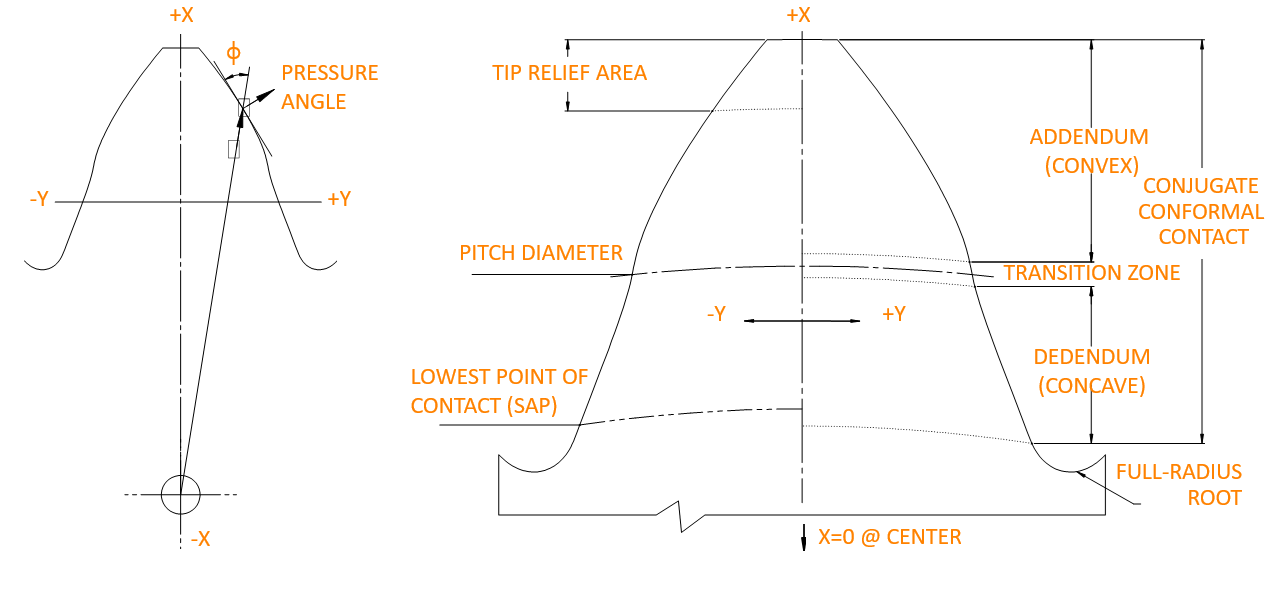
Each Convoloid tooth has a characteristic S-curved profile. The dedendum (below pitch line) is concave; the addendum (above pitch line) is convex. This creates the conformal, lower-stress contact.
Unlike involute gears, Convoloid has no base circle, eliminating undercut constraints on small pinions. More design freedom, optimized for each application via computer point-by-point calculation.
Convoloid is conjugate through most of the addendum and dedendum, with contact that accurately follows the Euler-Savary equation. Nearly constant relative radii of curvature maintain consistent Hertz stresses across the entire flank. No stress spikes.
Convoloid is made on existing gear-cutting, grinding and inspection equipment at standard cycle times, and manufacturing sequences mirror involute processes. The transition is a design change, not a capital investment.
These aren't illustrations. Every gear below is generated from the Convoloid® basic rack (convex addendum, concave dedendum, S-shaped transition through the pitch line) using the same rolling motion a hob uses on the shop floor. The amber dashed curve is the true path of contact; glowing points are live tooth contact.
Watch a standard 20° involute tooth become a Convoloid tooth. The flank turns into an S: a convex addendum above the pitch line, a concave dedendum below it, joined by a smooth transition where every junction is tangent.
The amber comb plots curvature along the flank. It flips sign at the pitch line, so a convex flank always meets a concave flank.
A 13-tooth pinion driving 27 teeth. With no base circle there's no undercut limit, and the contact ratio stays above 1.0, so spur Convoloid gears run smoothly.
The same transverse Convoloid profile swept along a 22° helix, in opposite hands. Contact lines stay unbroken across the full face width.
A 30° double helix cancels axial thrust. It's built for the heavy-duty drives (wind, mining, marine) where power density matters most.
A 21-tooth sun, three 15-tooth planets and a 51-tooth internal ring. The ring is generated to match the planet, so internal meshes get the same convex-to-concave contact.
This is the rack that defines the whole Convoloid system. Every gear above is generated from it, which is why Convoloid can be cut on existing CNC hobbing and grinding machines.
At the mesh, a convex addendum rolls against a concave dedendum. The two curves nest instead of touching at a single sharp point, so the load spreads over a wider band and contact stress drops.
Most licensors spend years and millions building test evidence. Convoloid has a federal test program, a published AGMA rating method, and the reports to back them. We call analysis analysis and test results test results, and every number names its baseline.
Tested under a U.S. DOE/NREL wind-energy research contract (2005–2008). A Convoloid retrofit of a 108 kW two-stage wind gearbox ran back-to-back against an optimized involute at up to 240% of rated load. Convoloid tooth surfaces stayed stable while the involute's micropitting progressed.
DOE/NREL Contract Program →Published at the AGMA Fall Technical Meeting (Berlinger & Colbourne, 2011). "Convoloid Gearing Technology: The Shape of the Future" sets out design procedures, rating criteria, and apples-to-apples comparisons with equivalent involute designs.
Rated per AGMA/ISO against an equivalent involute baseline, with the same dynamic, life and load-distribution factors applied to both forms. On that basis Convoloid shows 20–35% higher torque capability than equivalent involute designs.
US 10,527,149 in force to ~2036. European patent EP 3 387 294 granted, with Unitary Patent and UK validation, to 2036. Supported by the CONVOLOID® trademark and unpublished design software, protocols and know-how.
US & EP · to ~2036 →Published at AGMA (11FTM19), in Gear Solutions, and in a 247-page NREL final report, backed by an internal library of design, rating, manufacturing and application papers available under NDA.
See the Sources →Convoloid design and rating work has been run in Gear Innovations software integrated with ANSOL Transmission3D. The same software computes the Convoloid and involute variants, so both are rated on identical terms. Point-by-point computation tailors the tooth to each application.
Convoloid gearing has been tested against involute baselines in a U.S. Department of Energy wind gearbox program and at Penn State's Gear Research Institute. In both, the involute baseline was built to the same constraints as the Convoloid gears.
Tested under a U.S. DOE/NREL wind-energy research contract (2005–2008). A Convoloid retrofit of a 108 kW two-stage wind gearbox ran back-to-back against an optimized involute at up to 240% of rated load. Convoloid tooth surfaces stayed stable while the involute's micro-pitting progressed. The test ended with an intermediate-shaft bearing failure unrelated to the gears.
Early Convoloid micro-pitting on the transition zone self-arrested and contact improved (“wear-in”); the involute's micro-pitting progressed to the end of the test with rising noise, vibration and metal in the oil. The bearings were stock-sized, with marginal rated life at 240% load; Convoloid gear wear was unchanged at test end. Early in the program the rig ran below its intended load for a period because of an instrumentation conversion error, which the report documents. Noise results apply to steady, high-load duty only; we make no noise claims for light- or variable-load duty. (Convoloid 13 teeth vs involute 16 on the high-speed pinion, so mesh frequencies differ.) Read the NREL final report →
Request the DOE/NREL Test Report
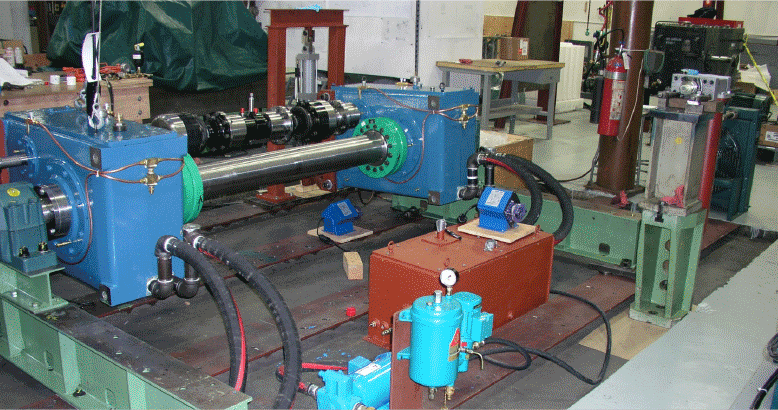
Penn State Gear Research Institute four-square testing confirmed Convoloid's surface-durability advantage and rating protocol; tooth form was the only change.
Penn State testing used 28–32 HRC through-hardened AISI 4140, the material regime of large cast gears.
The differences between a Convoloid tooth and its involute equivalent are subtle, but they produce powerful results. Manufacturing sequences, tolerances and material allowances closely follow involute practice.
Hobbing, shaping, skiving, form grinding and threaded-wheel grinding all apply, at standard cycle times, and hob costs are comparable to special involute cutters. Shaving is not recommended. Pinion and gear need separate cutters. Because the tooth is described digitally, it is compatible with the CNC gear manufacturing and inspection equipment in use worldwide.
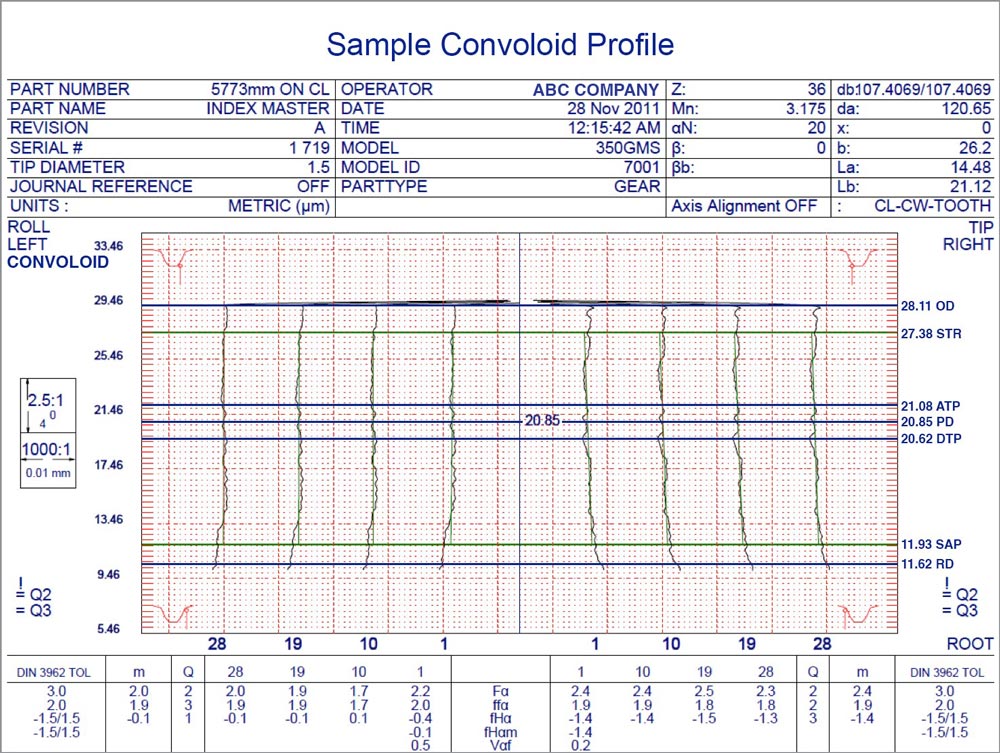
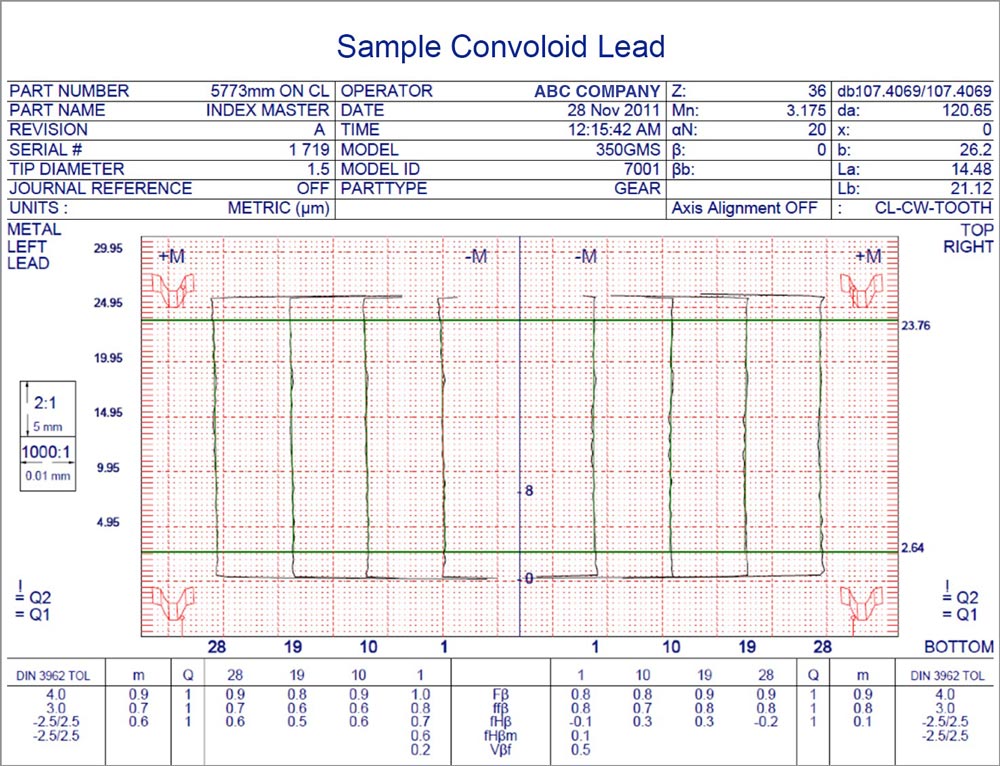
Inspected on standard CNC gear checkers to AGMA, ISO, DIN and JIS quality grades. Accuracy classes use the same parameters, limits and identification. Lead modification, crowning, tip relief and root relief can all be designed in and measured. Center-distance tolerance practice is ±0.005 × transverse module.
Rating modifiers and tolerances from world-recognized standards apply directly:
| Analysis | AGMA | ISO |
|---|---|---|
| Contact & bending | 2001/2101, 6011, 6013, 6015 | 6336, 13593 |
| Tolerances | 2015-2 | 1328-1 |
| Inspection | 915 | 10064 |
| Scuffing | 925 | 13989, 14635-1 |
Convoloid's evidence is strongest in large, heavily loaded gearing: mills, kilns, wind and industrial drives. Other markets follow as the validation record grows.
Mill, kiln and heavy drives where a stop halts production and capacity is fixed by metallurgy. Backed by a DOE/NREL gearbox test at 200–240% of rated load, with lower measured noise and vibration at high load.
Tested under a U.S. DOE/NREL wind-energy contract: a Convoloid retrofit of a 108 kW two-stage gearbox ran at up to 240% of rated load, with stable tooth surfaces while the involute's micro-pitting grew.
Parallel-axis and planetary product lines. 20–35% higher torque capability than equivalent involute designs (AGMA 11FTM19), made on the machines you already own: a design change, not a new factory.
Rotorcraft and ground-vehicle gearboxes (analysis only; not yet tested at defense duty cycles). UAV and actuator scale: validation partner sought.
Analysis shows ~20% volume and weight reduction at equal power and stresses, and higher single-stage ratios that can replace a two-stage reduction with one Convoloid pair. Light-load noise behavior is still being characterized.
Mass and torque density define humanoid joints. Convoloid has not yet been analyzed or tested at the fine pitches robot joints use, and we are seeking a robotics partner for a fine-pitch validation program.
A licensee gets more than patent rights: the tooth-geometry protocols, design software, published rating method, application know-how and the CONVOLOID® trademark.
Gear Innovations licenses Convoloid directly and neutrally. There is no master licensee that competes with sub-licensees. A small, per-unit royalty on gears you already make, on machines you already own.
Per-unit royalty model. Arm-style. We license the design method and IP rights; you bake Convoloid geometry into gears you already manufacture.
No new machine tools required. Convoloid is made on existing gear-cutting and inspection equipment. Manufacturing sequences closely match involute processes.
A technical library of design, rating, manufacturing and inspection papers, plus application modeling and design support for your program.
A 30-minute technical call to confirm gear-type fit for your application and answer your engineers' first questions.
Application modeling and design support at your gear ratios, loads and materials, so the advantage is quantified before any commercial conversation.
Simple direct license agreement. We transfer the design files, protocols and design support to integrate Convoloid into your product line.
No commitment. We'll confirm the fit first.
Son of Convoloid inventor Bernard Berlinger, Jr., Darryl has taken the helm of Gear Innovations to bring Convoloid to global markets. Carrying forward his father's vision, Darryl leads commercialization, licensing strategy, and industry partnerships for this breakthrough technology.
Co-presenter of the AGMA Convoloid case studies webinar and co-author of technical papers on Convoloid implementation. Allen brings deep gear engineering expertise to application-specific design, licensing technical support, and heavy-industry engagement. His framing of Convoloid's longevity and lifetime-cost advantages resonates powerfully with mining, wind, and large industrial drivetrain operators.
A registered P.E. (University of Missouri, BSME), Allen spent 16 years at the Dorris Company, finishing as Senior Project Engineer. Since 2005 he has led the multi-year Gear Innovations test program under the U.S. DOE/NREL wind-energy research contract. An AGMA member since 1991, he has chaired the AGMA Computer Programming Committee since 1997 and serves on the Wind Turbine TAG.
Gregg keeps Gear Innovations' technology aligned with its business: the digital presence that introduces Convoloid to engineers and partners, the secure handling of technical data shared under NDA, and the systems behind licensing and partner engagement. His strength is translating between the technical and the commercial, so every tool the company adopts serves a clear business purpose and every risk is managed before it becomes a problem.
Gregg brings more than two decades of technology leadership. He began his career as a broadcast engineer for local news affiliates and later worked in private aviation before moving into financial services, where he has led technology for investment firms and broker-dealers operating under SEC and FINRA oversight. Along the way he spent ten years building and running a managed IT services firm that supported small and mid-sized businesses across the Philadelphia and New York regions. A CISSP with multiple Cisco and industry certifications, he holds a bachelor’s degree from Millersville University and a master’s degree from Syracuse University, and is completing a Doctor of Business Administration in Information Systems.
Barney founded Gear Innovations LLC in 1997 after founding ASI Technologies Inc. a decade earlier. He was the named inventor or co-inventor of the patents that define Convoloid technology, including the foundational US 6,101,892 and US 10,527,149, both with Dr. John Colbourne. He spent decades developing, testing and publishing the science behind Convoloid gearing. His work, tested under a U.S. DOE/NREL contract and published at AGMA, is the foundation of Convoloid technology.
An AGMA member from 1962, Barney chaired the Fine Pitch Gearing Committee, served on the Board of Directors and was AGMA President in 1986. He later chaired the Board of Trustees of the Gear Research Institute at Penn State (2000–2002). BSME, University of Pennsylvania, 1960.
Dr. Colbourne joined Gear Innovations in 1997 and was the kinematic mind behind the Convoloid tooth form. He co-invented the foundational Convoloid patents with Barney Berlinger and was sole inventor of US 6,964,210 (gear tooth profile) and US 7,077,026 (gear tooth profile curvature).
He was Professor Emeritus of Mechanical Engineering at the University of Alberta. He earned his BS in Mechanical Sciences at Cambridge, including a year of study at the Technische Hochschule Darmstadt, and his PhD in Kinematic Theory at Stanford. He chaired the AGMA Nomenclature Committee and received the AGMA Technical Division Executive Committee Award for outstanding contributions to the art of gear design and utilization. He passed away in June 2016.
Every claim on this site traces back to a patent, a published paper, or a test report. Here are the primary sources, including independent reviews. The technical data room is available under NDA.
Gear Innovations' full technical library (design, rating, manufacturing and application papers) is available to licensees under NDA.
Whether you're a gear manufacturer evaluating Convoloid for a product line, an OEM exploring a performance advantage, or a researcher in the field, we want to hear from you.