Two Test Programs
Convoloid gearing has been tested against involute baselines in a U.S. Department of Energy wind gearbox program and at Penn State's Gear Research Institute. In both, the involute baseline was built to the same constraints as the Convoloid gears.
Wind Turbine Gearbox, 200–240% of Rated Load
Tested under a U.S. DOE/NREL wind-energy research contract (2005–2008). A Convoloid retrofit of a 108 kW two-stage wind gearbox ran back-to-back against an optimized involute at up to 240% of rated load. Convoloid tooth surfaces stayed stable while the involute's micro-pitting progressed. The test ended with an intermediate-shaft bearing failure unrelated to the gears.
- Gearbox
- Micon 108 kW, two-stage
- Baseline
- Optimized involute
- Housing
- Existing involute housing
- Load
- 200%, then 240% of rated
- Efficiency
- 98.9% per gearset, both (parity)
- Contract
- DOE/NREL ZAM-3-33200-12
Early Convoloid micro-pitting on the transition zone self-arrested and contact improved (“wear-in”); the involute's micro-pitting progressed to the end of the test with rising noise, vibration and metal in the oil. The bearings were stock-sized, with marginal rated life at 240% load; Convoloid gear wear was unchanged at test end. Early in the program the rig ran below its intended load for a period because of an instrumentation conversion error, which the report documents. Noise results apply to steady, high-load duty only; we make no noise claims for light- or variable-load duty. (Convoloid 13 teeth vs involute 16 on the high-speed pinion, so mesh frequencies differ.) Read the NREL final report →
Request the DOE/NREL Test Report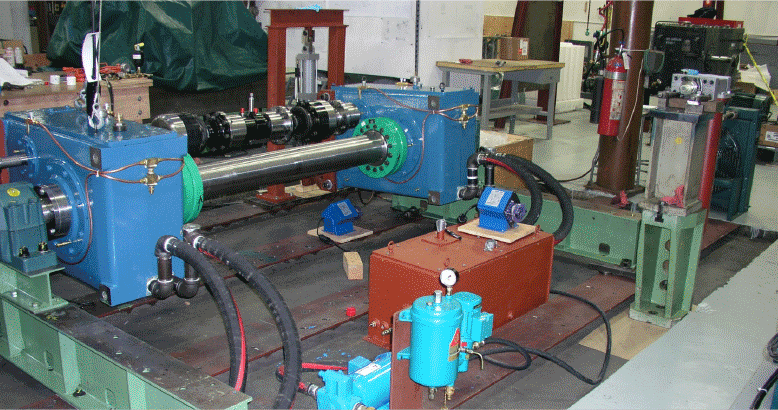
Four-Square Surface-Durability Testing
Penn State Gear Research Institute four-square testing confirmed Convoloid's surface-durability advantage and rating protocol; tooth form was the only change.
Penn State testing used 28–32 HRC through-hardened AISI 4140, the material regime of large cast gears.
- Rig
- Four-square
- Variable
- Tooth form only
- Material
- AISI 4140, 28–32 HRC